I met my first husband, John, while working as a typist for a news publication.
I’d worked for a number of news publications before I finally wound up at the most menial of publications, typing for The Thrifty Nickel in an old man’s converted garage.
My future husband used to bring his stories for me to type, and so did his twin brother. They had an alternative newspaper and it was distributed on the UNM campus in Albuquerque. There were 2 publications before their business folded because they were sued by the landlord for months of back rent on the large office building they had rented, just two blocks from the college campus. They sold ads to local businesses around the campus, got me to rent the back part of the office, which contained a small kitchen, bathroom and bedroom.
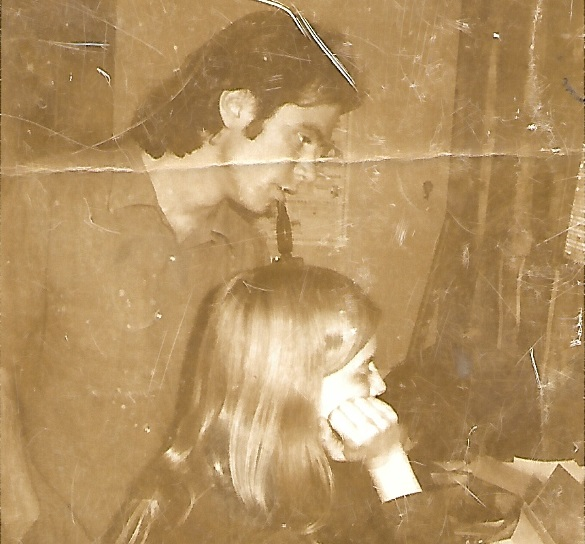
I was included in the lawsuit but taken off of it when I produced evidence that I had been paying my share of the rent. My boyfriend and his brother had not paid it, unbeknownst to me. This would be the first of many deceptions.
When I became his girlfriend, I began to accompany him on interviews, taking notes. He even asked me to take notes as he made comments while the evening news was on.
John, my boyfriend and future husband, told me that his younger brother, Daniel, who I had yet to meet, had become a follower of a person claiming to be the Messiah. The leader of this cult was Donald Hargrove, alias Cyrus, who had just recently jumped onto Billy Graham’s stage and tried to take the microphone from him.
Cyrus had a message for the world.
John, acting as news reporter, with his big camera in his hands, jumped up on Graham’s stage as well, following behind Cyrus. They both were carted off the stage and went to jail.
So I went with my boyfriend to this tiny little town of Magdalena to assist in conducting an interview with the curious man.
Magdalena is west of Albuquerque. Small, remote and a high elevation mountain base town. The drive to get there takes you from expansive desert views to those of lush forestry and pristine mountains in the distance. Just about halfway there, between Socorro and Magdalena, you’ll pass the big array of telescopes . It’s the observatory that Jody Foster used in the movie, Contact. The skies in New Mexico are brilliantly clear and, at higher, more remote elevations, they are spectacular, so thick with stars you can barely see dark sky at all. I can still recall that thick soup of stars. It took your breath away.
My boyfriend and I camped all over the state of New Mexico, carrying in all our food, cooking over campfires made from whatever kindling we could find, sleeping in tents under the stars. We slept on a malpais bed but mainly on forest floors. This is one of the few interests we really had in common.
I think we both felt alienated from the world at that point in our lives. I had returned to college, after being brought to my knees, again and again, by various family obligations which, in retrospect, should never have been mine.
John felt betrayed by his closest friends, and most importantly by his twin brother who did something so unspeakable that i should probably not go into detail now. But it caused him, as well, to leave college dorm and campus, return home to his parents, never to return to college again.
Both of us had an older sibling who bullied us. These are the things we shared.
We spent our down time sitting in coffee shops, across from the university. There was one that was open all night and served the most tender and delicious sweet roll, the Manske roll. We liked to drink our coffee and speak passionately about changing the world. We had different opinions on how that would or should happen.
But on to the interview.
The curious man, this self proclaimed Messiah, lived right next door to the sheriff, I was informed, as we stood at the front door of his humble home and waited for someone to answer our knock. Suddenly a large pit bull came charging toward us, from the side yard, but was stopped short by the large, heavy chain that it was on. It barked and snarled and snapped at us, it’s vicious, snapping teeth just inches from my legs.
When Cyrus opened the door, I jumped through the doorway as quickly as I could, to get away from the snapping teeth of the pit bull, only to fall two feet down into a muddy, wet living room whose floor had been removed, and grabbing onto the only thing available, a fat, greasy, old man who seemed to be wearing nothing but a thin robe.
I grabbed out for the man as I fell, I felt the gun that he was holding in the pocket of his robe . A creepy, awkward first encounter.
This visit would be full of surprises.
He escorted us across the kitchen into his bedroom, both of which had a floor. John and I sat in chairs across the room from the bed, while Cyrus sat on the edge of the bed. A small lamp beside him. The room was very dim.
After a while his young daughter came in. Her hair was limp, long and unkempt, and I thought she was a little boy when she first sat down by her father. Suddenly, she climbed up on her father’s lap and they began to make out passionately.
I honestly don’t remember what happened next, except that I was standing up and the room was swaying and Cyrus was laughing at me and daring me to complain about it. “Does this disturb you?” he said with great pride and arrogance. He explained to me, repeatedly, that he had brought her into the world and he was taking her body back to him, that it was his right since he had created her. “I brought her body into the world. I take her body back to me. Her flesh is my flesh and she belongs to me.”

I don’t even remember how I got out of the house.
I never returned to his home but a year later I moved to Socorro, and, to my surprise, my boyfriend had let them know where I lived and Cyrus brought his children to visit me in my little house in Lemitar.
By this time I was back in college, taking courses in Calculus, Physics, with a major in engineering, and working part time at the college library.
Cyrus learned from my boyfriend that I was upset by his visit so he called me on the phone. He said he’d heard I didn’t approve of his lifestyle and told me he could have me eliminated if I tried to interfere with his life. I asked him if he was threatening me and he said, that ‘no, he didn’t have to. God took care of his enemies for him. He told me that 2 lawyers who had done him wrong had dropped dead. Then he put his daughter on the phone.
Then little 12 year old Becky got on the phone and pleaded with me. “I know you think my Daddy is a bad man, and he can act mean, but I promise you that he’s not. He’s a good man. He’s not hurting me.” ………..
I was speechless. I didn’t want to hurt this little girl’s feelings or frighten her. I could hear her agony and her fear and it made me feel like a monster. I didn’t have the sense to tell the authorities. I didn’t realize there were authorities to tell. If I had known, I probably would have called them concerning my own siblings.
Somehow, believe it or not, I didn’t know that there were laws that could have protected her. Just like I hadn’t known there were laws to protect my little sister, Marilyn or little brother, Johnny.
I’d already been traumatized, year after year, by the events of a dysfunctional family, and the suffering of my little sister. I should have screamed louder and harder and longer. For the most part, I remained silent and traumatized. I did tell my mother and step-father, however, repeatedly, about the cult, about Becky and her little sister, Rachel, who also fell victim and suffered even worse psychological damage. My mother was a medical examiner in Albuquerque at the time and my step-father was a New Mexico State Senator. In retrospect, I wonder why neither of them had the sense to turn this information in to authorities.
I told everyone in my world of authority…. my parents, John’s parents, one of my bosses at NASA in Sunspot, NM, my divorce attorney who soon after became a judge. You would think someone in that group would have know to turn the information in to the proper authorities. None of them did. I did finally turn it in when I moved to Texas and learned from my daycare job that there were agencies for child abuse.
So I turned it in and a most inexplicable thing happened. I spoke with someone from Texas CPS and described everything that I knew. Someone called me back a few days later and told me that they knew I wouldn’t believe it but they had spoken with authorities in the Magdalena area who responded that they were aware of the situation but their hands were tied for some reason.
The person who spoke with me assured me they weren’t going to let it go and planned to continue to pursue and try and get some action taken. It doesn’t appear they ever succeeded because the girls did not escape Cyrus until they were both grown women, seven years later. The agency never got back to me and the abuse went on for seven more years, until my ex found a new woman who turned them all in, five years after they’d left the situation themselves. It took them five years, five more years of the girls and the granddaughters being raped, before they walked into a police station. They wanted to make sure that my ex and his brother both receive immunity from their participation in pedophilia and child rape, before they would testify in the trial that resulted in two consecutive life sentences for Cyrus.
By the time my daughter was born my little sister had committed suicide and I was completely devastated and paralyzed with grief. I’m so sorry that Becky was just not on my radar too often back then. Now she is gone. A drug overdose, I heard. Just before she left this earthly existence, she made efforts to share her story with others. She wanted justice. I don’t know any of her story first hand beyond what I’ve shared.
I did not know my ex participated until she came forward 45 years later, reported it on facebook, on my daughter’s page. Her son belonged to my ex, proved through DNA. She had a daughter who was proven to be that of my brother-in-law, who still celebrates his immunity. On his page, Becky posted that he had abused her. This crushed me to hear. I always thought she probably preferred him to her disgusting father, but apparently, he was equally disgusting. And he was using her before she had breasts, any sign of development. I believe this is what’s called a pedophile and I’ve been told that many in the family believe the behavior continues. I am, of course, the only one who is ostracized from this group and made to be the villain. Shame on me who tells the truth, right?
I was room-mates for a while back then, in the days of the cult, with the girlfriend of John’s little brother, the cult member. She came home one day quite shaken and described a scene that chilled me to the bone back then and still to this day gives me shudders.
Daniel took Dori, my room-mate, to Cyrus’ home and asked her to have sex with Cyrus so that he could have sex with 12 year old Becky. I would discover later that Daniel had been engaging in sex with this little victim when she was eleven.
Dori refused and ran out the door and down a long dirt road … Magdalena was a small town with a lot of long, dirt roads. Daniel followed her in his car, shining his lights on her, while she ran down the dark road on foot. She was a strong woman, thank God, and never allowed Cyrus to touch her. Last I heard she started up a successful jewelry trading business in Albuquerque, buying turquoise stones at the flea market and then selling her homemade necklaces on the side of the highway until she got so wealthy she started flying to New York with her jewelry and moved there to continue in the jewelry business. I’m so grateful that she got away from the monsters unscathed.
John himself confirmed to me that Cyrus shared his young daughter with strangers passing through. This information I also shared with everyone I knew. I’ve never stopped talking about the cult and a curious thing I’ve noticed is that a lot of people don’t seem too concerned about it while others are quite shocked and almost disbelieving.
I never dreamed that my ex participated, in fact produced a child with her, and she fell in love with him. Then he apparently left her for another woman, never claiming his second child, his son. The woman, Becky, put a message on my daughter’s page in 2021, informing her that she had a 35 year old half brother who did not want to meet her due to the circumstances of his conception. DNA proved my ex was the father. Becky also put a message on Daniel’s page saying that he had been very cruel to her. Daniel and his wife were enraged at Becky’s posted, so they removed it and blocked her. They say she died of a drug overdose shortly after that post, and Daniel’s wife fell down the stair mysteriously. Daniel’s own children and niece suspect fowl play. Becky’s final request was that people search for her story. She said it was on line and she was correct. Before I share the link I must add that Becky had a sister by the name of Rachel, 4 years younger, who was also treated in the very same way as Becky. She is included in this court case, along with Becky. My ex and his brother are the 2 witness/followers, and my brother-in-law’s wife, now institutionalized, is mentioned in the case. I was never told about the trial until it was over because my ex never wanted me to know about his level of participation.
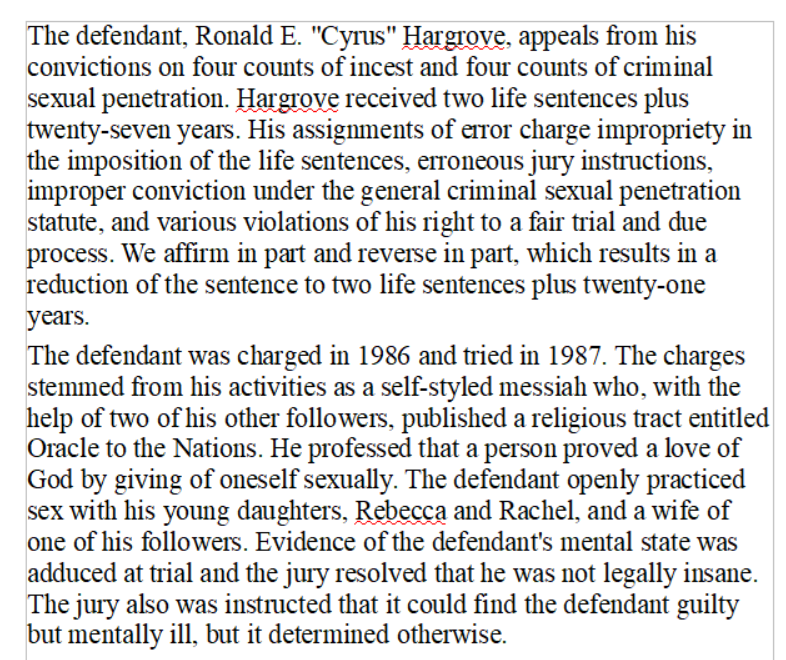
The court case – 2 life sentences plus 21 years
When people would suggest to me that my ex would have anything to do with the incest, I would shake my head at their failure to understand. I was certain he would never be that kind of man. I lived with that illusion for over 40 years before the truth came out. And I’m still trying to digest it.
So, I feel compelled to try and get this story out, once and for all.
I have discovered , sadly, that there are women … and other codependents … some would call enablers … who are able to excuse the most vile behavior in a man if that particular man makes them happy and fulfills their emotional needs, whatever those might be …
this is the truth … I’m putting it out there as it seems that it’s time. I think I should be allowed to speak after being silenced for decades.
Links to the court case:
https://law.justia.com/cases/new-mexico/supreme-court/1989/17559-0.html
https://www.leagle.com/decision/1989937771p2d1661937


For your convenience, a copy of the full transcripts that Becky asked us all to find and to publicize.
A Message from Becky:
State v. Hargrove
771 P.2d 166 (1989)
108 N.M. 233
The defendant, Ronald E. “Cyrus” Hargrove, appeals from his convictions on four counts of incest and four counts of criminal sexual penetration. Hargrove received two life sentences plus twenty-seven years. His assignments of error charge impropriety in the imposition of the life sentences, erroneous jury instructions, improper conviction under the general criminal sexual penetration statute, and various violations of his right to a fair trial and due process. We affirm in part and reverse in part, which results in a reduction of the sentence to two life sentences plus twenty-one years.
The defendant was charged in 1986 and tried in 1987. The charges stemmed from his activities as a self-styled messiah who, with the help of two of his other followers, published a religious tract entitled Oracle to the Nations. He professed that a person proved a love of God by giving of oneself sexually. The defendant openly practiced sex with his young daughters, Rebecca and Rachel, and a wife of one of his followers. Evidence of the defendant’s mental state was adduced at trial and the jury resolved that he was not legally insane. The jury also was instructed that it could find the defendant guilty but mentally ill, but it determined otherwise.
As an initial procedural matter, we address the State’s objection to the submission on appeal of the defendant’s handwritten personal statement. The State correctly points out that the statement was not part of the record below, was not subject to cross-examination, and should not be considered on appeal. Upon further reflection, we believe that our leave to submit this statement was improvidently granted. The defendant’s personal statement will be stricken from the appellate record.
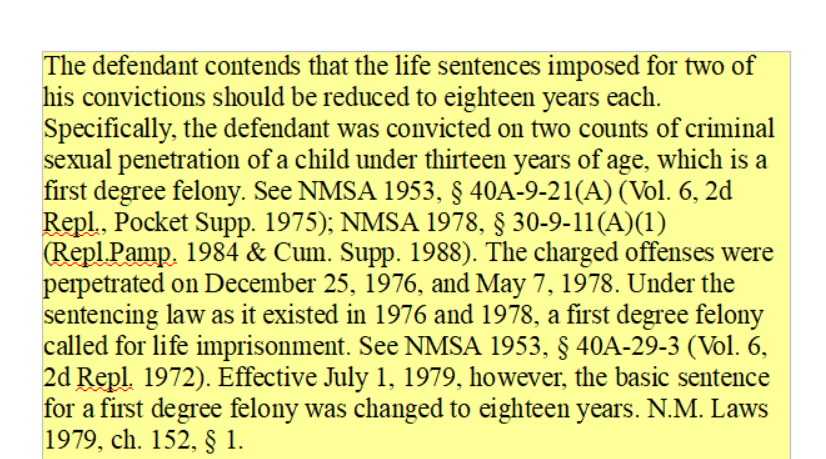
The defendant contends that the life sentences imposed for two of his convictions should be reduced to eighteen years each. Specifically, the defendant was convicted on two counts of criminal sexual penetration of a child under thirteen years of age, which is a first degree felony. See NMSA 1953, § 40A-9-21(A) (Vol. 6, 2d Repl., Pocket Supp. 1975); NMSA 1978, § 30-9-11(A)(1) (Repl.Pamp. 1984 & Cum. Supp. 1988). The charged offenses were perpetrated on December 25, 1976, and May 7, 1978. Under the sentencing law as it existed in 1976 and 1978, a first degree felony called for life imprisonment. See NMSA 1953, § 40A-29-3 (Vol. 6, 2d Repl. 1972). Effective July 1, 1979, however, the basic sentence for a first degree felony was changed to eighteen years. N.M. Laws 1979, ch. 152, § 1.
To support his argument, the defendant relies upon NMSA 1978, Section 31-18-13 (Repl.Pamp. 1987), which states that “[u]nless otherwise provided in this section, all persons convicted of a crime under the laws of New Mexico shall be sentenced in accordance with the provisions of the Criminal Sentencing Act [31-18-12 to 31-18-21 NMSA 1978].” The defendant maintains that the language mandates that he be sentenced under the new act, as opposed to the old law, because he is a person who was charged and convicted after the Criminal Sentencing Act became effective. The defendant also cites authority for the proposition that where an amendatory statute mitigates punishment, the lighter sentence should be imposed, rather than the sentence in force when the offense was committed. See, e.g., In re Fink, 67 Cal. 2d 692, 63 Cal. Rptr. 369, 433 P.2d 161 (1967) (in bank); In re Estrada, 63 Cal. 2d 740, 48 Cal. Rptr. 172, 408 P.2d 948 (1965) (in bank); People v. Oliver, 1 N.Y.2d 152, 134 N.E.2d 197, 151 N.Y.S.2d 367 (1956).
The defendant’s reliance on Section 31-18-13 as well as on his cited authority is *168 misplaced. The legislature specifically enacted a transitional rule to provide sentencing guidelines for crimes committed prior to the enactment of the Criminal Sentencing Act. 1977 N.M. Laws, Chapter 216, Section 18, states that “[t]he provisions of * * * [the Criminal Sentencing Act] apply only to persons sentenced for crimes committed on or after its effective date. Prior law remains effective with respect to persons sentenced for crimes committed prior to the effective date of this act * * *.” The defendant acknowledges that the creation of penalties and their application is the exclusive prerogative of the legislature. See State v. Peters, 78 N.M. 224, 430 P.2d 382 (1967). The legislature clearly expressed its intent that for crimes committed prior to July 1, 1979, the sentencing provision in effect at the time of the commission of the crime controls. See Estrada, 63 Cal. 2d at 747, 48 Cal. Rptr. at 177, 408 P.2d at 953 (a saving clause expressly providing that the old law should continue to operate as to past acts controls so far as punishment is concerned). Accordingly, we will not disturb the imposition of a life sentence for each conviction of first degree criminal sexual penetration committed prior to July 1, 1979.
The defendant also seeks reversal of his convictions for incest. The defendant contends that the trial court failed to instruct the jury properly on an essential element of the offense. See Ortiz v. State, 106 N.M. 695, 749 P.2d 80 (1988) (if instructions fail to apprise jury on essential element of an offense, reversible error has been committed). In New Mexico, there is no uniform jury instruction for incest. The jury was instructed as follows:
For you to find the defendant guilty of incest as charged in Count ____, the state must prove to your satisfaction beyond a reasonable doubt each of the following elements of the crime: 1. The defendant had sexual intercourse with ____; 2. That ____ was the daughter of the defendant; 3. This happened in New Mexico on or about the ____ day of ____.
The blanks above contained the number of the appropriate count, the name of either Rebecca or Rachel Hargrove, and the date of the alleged commission of the offense.
The defendant argues that the jury should have been instructed that it had to find that the defendant had knowledge of the prohibited degree of consanguinity. NMSA 1978, Section 30-10-3 (Repl.Pamp. 1984) states: “Incest consists of knowingly * * * having sexual intercourse with persons within the following degrees of consanguinity: parents and children * * *.” See State v. Hittson, 57 N.M. 100, 254 P.2d 1063 (1953) (where this Court recognized knowledge of the prohibited relationship as an element of incest); see also, e.g., State v. Moore, 242 Kan. 1, 748 P.2d 833 (1987) (aggravated incest requires that prohibited sex act be performed with victim under eighteen who is within required degree of kinship, and offender is aware of relationship); State v. Vincent, 278 N.C. 63, 178 S.E.2d 608 (1971) (sexual intercourse with woman or girl whom defendant knows to be his daughter constitutes incest).
The State initially responds that the defendant failed to raise and preserve any alleged error. Four months before trial, the public defender who then represented the defendant filed a requested knowledge instruction for the incest counts involving each daughter, as well as an instruction that specifically stated that proof of blood relationship is an essential element. See State v. Garcia, 100 N.M. 120, 666 P.2d 1267 (Ct.App.) (by tendering a legally correct statement of the law, defendant preserves trial court’s error in failing to give proper instruction), cert. denied, 100 N.M. 192, 668 P.2d 308 (1983). However, the public defender contemporaneously moved for and was granted withdrawal of her representation and, at trial, during the review of jury instructions, the defendant’s counsel assented to instructions that omitted the essential element of knowledge. The trial court was not called upon to rule on the earlier requests. To preserve error in the failure of the court to give a proper instruction, it is necessary to call the tendered instruction to the attention of the *169 court for a ruling. SCRA 1986, 5-608(D); Budagher v. Amrep Corp., 97 N.M. 116, 637 P.2d 547 (1981), appeal after remand, 100 N.M. 167, 667 P.2d 972 (Ct.App.), cert. denied, 100 N.M. 192, 668 P.2d 308 (1983).
The State concedes that failure to instruct on an essential element may be raised for the first time on appeal, see State v. Bell, 90 N.M. 134, 560 P.2d 925 (1977), but maintains that the jury instructions, read as a whole, properly included the essential elements of the crime of incest. The State argues that the jury was instructed on the definition of “intentionally” and asserts that “intentionally” is an adequate substitute for “knowingly”. We do not agree that the instruction, which informs the jury of the necessity to find general criminal intent in addition to the other elements of the charged offense, SCRA 1986, 14-141, was sufficient to instruct the jury that knowledge of the prohibited blood relationship is an essential element of incest. As stated in Hittson, “the free act of the one being tried, with knowledge of the relationship” is required to convict one of incest. 57 N.M. at 102-03, 254 P.2d at 1065 (emphasis added). Knowledge and intent are separate, not synonymous, elements.
The failure to give an instruction on an essential element is jurisdictional and reversible error unless the defendant affirmatively has conceded the facts underlying the essential element. Ortiz, 106 N.M. at 698, 749 P.2d at 83. In this case, if the defendant’s knowledge that he was the father of either Rebecca or Rachel was not factually in issue, then the error in the instruction would be nonjurisdictional and would require proper preservation for review. Cf. Bell, 90 N.M. at 140, 560 P.2d at 931 (decision resting on either “not factually at issue” or “subsidiary fact” rationale).
At oral argument, a question also was raised concerning whether prohibited relationships under Section 30-10-3 include a child fathered by someone other than the defendant during defendant’s marriage to the mother. The relevance of this question stemmed from defendant’s testimony that, at the time of the offense, he believed Rebecca to have been fathered by another man during the time the defendant was married to Rebecca’s mother. If the defendant’s knowledge that he was the biological father of Rebecca was factually in issue, then error in failure to instruct on the essential element of knowledge would be jurisdictional and should be considered by us notwithstanding defense counsel’s decision, tactically or otherwise, to have Rachel and Rebecca treated alike.
| The argument Cyrus made is a complete and total lie, and I could have testified to that. Cyrus yelled at me, repeatedly, as I was running out of his house, that he had a right to his daughter’s body because her flesh had come from his flesh. Now look how he carries on in paragraph after paragraph, claiming that he never believed that Rebecca was his real daughter. What a lie! If my ex and his wife had let me know about the lawsuit, I would have testified to this, but they did not breathe a word to me about it. Forty years later, I finally understand why. They did not want me to learn the full truth. I already knew that the little brother, my brother-in-law, follower #1, traded his wife in order to have sex with an eleven year old girl who looked like a little boy because she had not begun to develop. He raped her for a decade at least. I’m not sure when eight year old Rachel became a part of that. What my ex tried to prevent me from knowing is that he also joined in and created a child with Rebecca. I will never know when he began this relationship with her. I never dreamed that he could cross that line, after knowing she’d been raped by his brother and father for at least a decade, I still cannot believe he joined in and then left her to fend on her own for the rest of her life. A large part of me was shattered when I learned, 40 years later, how this man had betrayed so many people on so many levels. I get very angry when I see that Cyrus lied in court. I get angry because I could have testified and no one included me. They made a point to keep me in the dark entirely about this court case, while I was raising his daughter alone in Texas without a penny of child support from him. The deception never ended. Most, or all, of the family would prefer the truth remain buried, which disappoints my heart to it’s depth. |
A majority of jurisdictions have incest statutes that prohibit engaging in sexual intercourse with stepchildren.[1]See, e.g., Ala. Code § 13A-13-3 (1988); Ark.Stat.Ann. § 5-26-202 (1987); Colo. Rev. Stat. § 18-6-301 (Repl.Vol. 1986); Del. Code Ann. titl. 11, § 766 (Repl. Vol. 1987); Ky. Rev. Stat. Ann. § 530.020(1) (Michie Repl. 1985); Mont. Code Ann. § 45-5-507 (1987); Wash. Rev. Code Ann. § 9 A. 64.020 (West 1988). The prohibition against consanguineous incest serves the policy objectives of preventing the unhealthy genetic consequences of interbreeding, promoting family harmony, and protecting children from abuse of parental authority. See C. Torcia, Wharton’s Criminal Law § 242 (14th ed. 1979). Incest statutes that also criminalize sexual intercourse between step relations serve the latter two policy objectives. See id. at § 245, at 407 n. 30.
The language of our incest statute, however, precludes such an application. A criminal statute is to be construed strictly. State v. Allen, 77 N.M. 433, 423 P.2d 867 (1967); see also State v. Moore, 158 Conn. *170 461, 262 A.2d 166 (1969). Further, words used in a statute are to be given their ordinary and usual meaning unless a different intent is clearly indicated. Schmick v. State Farm Mut. Auto Ins. Co., 103 N.M. 216, 704 P.2d 1092 (1985). The term “consanguinity” admits of only one plain meaning. It is the relationship by descent from the same stock or common ancestor; related by blood. Black’s Law Dictionary 275 (5th ed. 1979); Oxford English Dictionary 845 (Vol. II 1970); Webster’s Third New International Dictionary 482 (1981). “Consanguinity” is to be distinguished from “affinity”, which pertains to relationships formed by marriage. State v. Geddes, 101 N.H. 164, 136 A.2d 818 (1957). Section 30-10-3 is directed toward prohibiting sexual intercourse between specific relations within the blood line. Those statutes that further prohibit sexual intercourse between specific relationships within the family regardless of any sharing of blood do not speak exclusively in terms of consanguinity, but rather specifically address relationships created by affinity and/or adoption.
Concerning Rachel, we conclude that the issue of whether the defendant knew that she was his biological daughter never was factually in issue. On direct examination, the defendant stated that he did not have sexual relations with Rachel because he knew that she was his daughter. From the testimony adduced at trial, it appears that the defendant affirmatively conceded the issue of knowledge. Consequently, the failure to instruct on this essential element for Counts I and VII was not jurisdictional error and any defect in the instruction was not preserved because at trial the defendant neither tendered proper instructions nor objected to the ones submitted. See Bell, 90 N.M. at 143, 560 P.2d at 934.
Rebecca presents a different case. The defendant testified that he believed he did not father Rebecca, although at trial he acknowledged that he now accepted her as his biological daughter based upon the result of blood tests conducted in preparation of trial. The issue, however, was whether the defendant knew Rebecca was his biological daughter when the acts of sexual intercourse charged in Counts II and VIII were committed. The defendant’s testimony that at one time he believed Rebecca to be his “adopted” daughter demonstrates that the defendant did not concede that at the time he had intercourse with Rebecca he knew she was his biological daughter. Accordingly, the failure to instruct the jury that, as an essential element of incest in Counts II and VIII, it had to find beyond a reasonable doubt that the defendant had knowledge of the prohibited blood relationship requires that the convictions on those counts be reversed.
The defendant further maintains that his convictions for criminal sexual penetration must be reversed because the incest statute, Section 30-10-3, is the more specific statute, and the State, consequently, properly could not charge and convict him under Sections 30-9-11(A)(1) and (B)(1), the more general criminal sexual penetration statutes. Relying upon State v. Blevins, 40 N.M. 367, 60 P.2d 208 (1936), the defendant contends that where a more specific statute exists, the state does not have the authority to prosecute under the general statute. See id. at 368, 60 P.2d at 209. In Blevins, the defendant was convicted of selling, without authorization, neat cattle. The defendant was charged under the general statute that made it a crime to sell the property of another without authorization, rather than under a statute specifically outlawing the unauthorized sale of neat cattle. The Court reversed the conviction concluding that because each statute prohibited the unauthorized sale of the property of another, “they describe but one offense, and, one of such statutes being special and the other general, the special statute should control to the extent of compelling the state to prosecute under it.” Id. at 369, 60 P.2d at 210.
Here, the defendant argues that the offense of criminal sexual penetration under Sections 30-9-11(A)(1) and (B)(1) concerns the general subject of sexual intercourse with children whereas the incest statute more specifically addresses the prohibition of sexual intercourse between fathers and daughters, the situation involved in this *171 case. The flaw in the defendant’s argument rests in his assertion that both statutes condemn the same offense. See State v. Ross, 104 N.M. 23, 25, 715 P.2d 471, 473 (Ct.App. 1986) (“In order for a specific offense to prevail over the more general crime, the two statutes must proscribe the same act.”). Criminal sexual penetration and incest have different elements and are distinct crimes even though one offense can occur simultaneously with the commission of the other. See Moore, 242 Kan. at 4-5, 748 P.2d at 835-36; State v. Harvell, 45 N.C. App. 243, 262 S.E.2d 850, appeal dismissed, 300 N.C. 200, 269 S.E.2d 626 (1980).
The gravamen of the crime of incest, as of rape, is the unlawful carnal knowledge. In rape it is unlawful because accomplished by unlawful means. In incest it is unlawful, without regard to the means, because of consanguinity or affinity. Where both the circumstances of force and consanguinity are present * * * it is not less incest because the element of rape is added, and it is not less rape because perpetrated upon a relative.
Hittson, 57 N.M. at 102, 254 P.2d at 1065 (quoting People v. Stratton, 141 Cal. 604, 75 P. 166, 167 (1904)).
In the present case, proof of two distinct elements was necessary to find the defendant guilty of the charged offenses of criminal sexual penetration and incest, respectively. The latter offense required a showing of the defendant’s knowledge that he had sexual intercourse with someone within the prohibited degree of consanguinity. The former required a showing that the defendant had sexual intercourse with a child under the age of thirteen, Section 30-9-11(A)(1), or alternatively, used his position of authority to coerce a child between the ages of thirteen and sixteen to engage in sexual intercourse, Section 30-9-11(B)(1). For the incest offense, the age of the relation within the prohibited degree of consanguinity was immaterial. For purposes of criminal sexual penetration, the relationship of the victim to the defendant was immaterial (the victim not being the defendant’s legal spouse).
Furthermore, each statute is directed toward achieving different policy objectives. The sanction against the criminal sexual penetration of children is to punish engaging in sexual intercourse with those who, because of age, are incapable to decide freely whether they want to engage in such conduct. The purpose of prohibiting incest is to prevent sexual intercourse between close relatives. There was no error in charging this defendant on separate counts of criminal sexual penetration and incest under a theory that he had sexual intercourse with a child under thirteen years of age and a child between thirteen and sixteen years of age, and he knew each was his biological daughter.
The defendant also submits that various alleged errors in the trial process violated his constitutional rights. He first contends that the trial court’s refusal to allow him to read aloud from the Oracle to the Nations denied him the right to present his defense in violation of due process. See In re Miller, 88 N.M. 492, 542 P.2d 1182 (Ct.App.), cert. denied, 89 N.M. 5, 546 P.2d 70 (1975); see also N.M. Const. art. II, § 14. The trial court disallowed the defendant’s reading of the Oracle to the jury because it was already an admitted exhibit and an oral presentation would have been unnecessarily time-consuming. The defendant acknowledges that a trial judge has the discretion to control trial proceedings to avoid the needless consumption of time and to allow for the effective presentation of evidence. See State v. Hovey, 106 N.M. 300, 303, 742 P.2d 512, 515 (1987). The defendant further recognizes that, absent an abuse of discretion, we will not disturb a trial court’s ruling on the admission of evidence. See State v. Smith, 92 N.M. 533, 537, 591 P.2d 664, 668 (1979).
The defendant’s contention that the trial court’s decision was an abuse of discretion is without merit. In Hovey, the defendant claimed that the trial court abused its discretion by limiting the number of diary entries that could be read to the jury and explained by the defendant. All sixteen hundred diary entries were admitted into *172 evidence and available to the jury. This Court found that the defendant was not deprived of an opportunity to present his defense because he was able to argue that the diary entries showed normal teenage behavior. 106 N.M. at 303, 742 P.2d at 515. Here, as part of his defense, the defendant was able to testify about the religious tenets embodied in the Oracle and to express his religious beliefs. To have allowed the defendant to read the Oracle aloud to the jury as well would have been needlessly cumulative. The trial court properly exercised its discretion pursuant to SCRA 1986, 11-611.
The defendant next asserts that evidence of another doctor’s opinion that the defendant was not psychotic or schizophrenic, but was a legally responsible person, which was elicited from the state’s rebuttal expert, was inadmissible hearsay and violated his right of confrontation. See Coulter v. Stewart, 97 N.M. 616, 642 P.2d 602 (1982) (experts may rely on hearsay under SCRA 1986, 11-703, but the hearsay itself is inadmissible). We initially note that no objection to the expert’s testimony was raised at trial. Under SCRA 1986, 12-216, failure to preserve a question by fairly invoking a decision by the trial court precludes appellate review.
One exception to that rule is where the claimed error is fundamental. We do not see that the error here was fundamental. The defendant has presented no argument that the admission of these statements went to the foundation of his case and deprived him of rights essential to his defense. See Smith v. State, 79 N.M. 450, 444 P.2d 961 (1968). Admittedly, the out-of-court statement that the defendant was a legally responsible person undermined his insanity defense. However, the defendant was not prevented from cross-examining the state’s rebuttal expert and calling into question the bases upon which he formed his opinion that the defendant was not legally insane. Furthermore, the defendant was able to present his own expert in support of his insanity defense. The doctrine of fundamental error “is not to be exercised in aid of strictly legal, technical or unsubstantial claims. Where substantial justice has been done, the parties must have taken and preserved exceptions in the lower court before this court will notice them on appeal.” Id. at 453, 444 P.2d at 964 (quoting State v. Lucero, 70 N.M. 268, 272, 372 P.2d 837, 840 (1962)).
The defendant further maintains that the failure to grant his motion for a change of venue denied him due process and a fair trial. It is within the sound discretion of the trial court to grant or deny a motion for change of venue. A ruling on such motion will not be disturbed absent a showing of abuse of discretion, and the burden of showing such abuse rests on the movant. State v. Rushing, 85 N.M. 540, 514 P.2d 297 (1973).
The defendant has failed to carry that burden. His allegation of abuse of discretion rests upon the trial court’s impaneling of jurors who admitted having been exposed to some publicity about the case but stated that they could be fair and impartial and would determine the case based on the evidence presented at trial. The constitutional standard of fairness does not require that jurors be totally ignorant of the facts and issues of the case. Murphy v. Florida, 421 U.S. 794, 95 S. Ct. 2031, 44 L. Ed. 2d 589 (1975). Furthermore, the defendant has made no showing that any of the jurors who actually heard the case were in any way tainted by the publicity. See Deats v. State, 80 N.M. 77, 80, 451 P.2d 981, 984 (1969). Without more, we cannot say that the trial court abused its discretion in denying the defendant’s motion for a change of venue.
Finally, the defendant asserts that there was insufficient evidence to support his convictions. Specifically, the defendant contends that the evidence did not demonstrate that he used his position of authority to coerce a child between thirteen and sixteen years of age to engage in sexual intercourse. See § 30-9-11(B)(1). Without detailing the extensive evidence regarding the defendant’s conduct toward Rebecca and Rachel, suffice it to say our review of the record belies this contention. There *173 was ample evidence to support each of the defendant’s convictions.
We affirm the defendant’s convictions on the charges of criminal sexual penetration, and on the charges of incest for Counts I and VII, but reverse and remand for a new trial on the charges of incest for Counts II and VIII.
IT IS SO ORDERED.
SOSA, C.J., and STOWERS, SCARBOROUGH and BACA, JJ., concur.
NOTES
[1] We recognize that the term “stepchild” to describe the status of a child who was born during marriage but who was not the issue of the husband is not technically correct. A stepchild is a child of one’s wife or husband by a former marriage. Webster’s Third New International Dictionary 2237 (1981). For purposes of addressing the parameters of Section 30-10-3, however, we believe that any prohibition against sexual intercourse with a stepchild would include a prohibition against intercourse with a child who was born during marriage but who was not the issue of the husband. Therefore, we look to those states that include step relations within the prohibition of their incest statutes for guidance in determining whether our statute can be read to include the same prohibition.
The highlighted argument above is a complete and total lie.
Cyrus yelled at me, repeatedly, as I was running out of his house,
that he had a right to his daughter’s body because her flesh had come from his flesh.
If my ex and his wife had let me know about the lawsuit, I would have testified to this, but they did not breathe a word to me about it. Forty years later, I finally understand why.
I already knew that the little brother, my brother-in-law, follower #1, traded his wife in order to have sex with an eleven year old girl who looked like a little boy because she had not begun to develop. He raped her for a decade at least. I’m not sure when eight year old Rachel became a part of that.
What my ex tried to prevent me from knowing is that he participated, he created a child with Rebecca. I will never know when he began this relationship with her. I never dreamed that he could cross that line, after knowing she’d been raped by his brother and father for at least a decade, I still cannot believe he joined in and then left her to fend on her own for the rest of her life.
A large part of me was shattered when I learned, 40 years later, how this man had betrayed so many people on so many levels.
I get very angry when I see that Cyrus lied in court. I get angry because I could have testified and no one included me. They made a point to keep me in the dark entirely about this court case, while I was raising his daugher alone in Texas without a penny of child support from him.
Most, or all, of the family would prefer the truth remain buried, which disappoints my heart to it’s depth. But that’s humanity for you.
 Oikos
Oikos 